
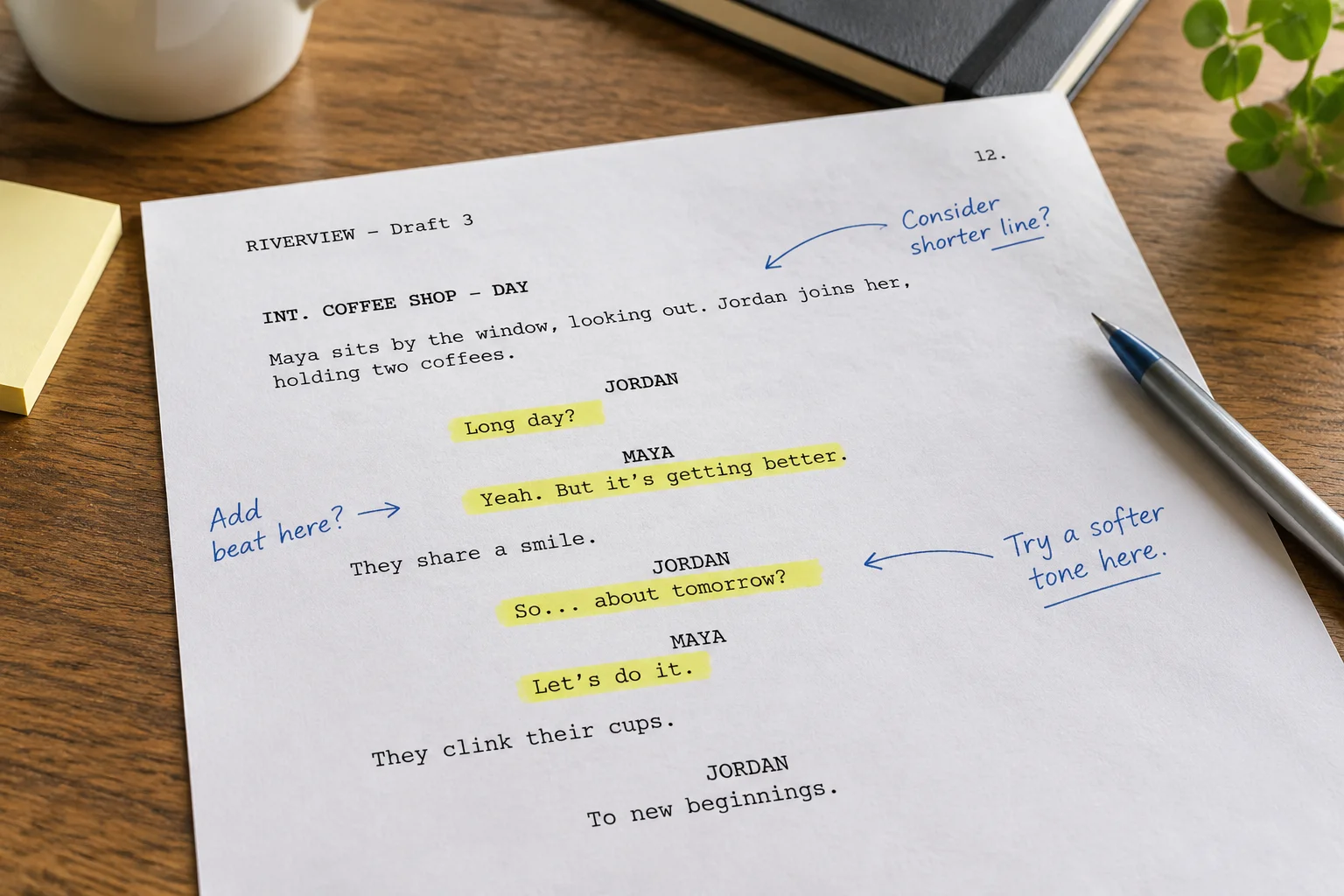
The Four Pillars of Script Version Transparency
Traceability in script revision is not merely about writing a date on a cover page. On an active film or television set, dozens of departmental crews depend on precision cues to know exactly what dialogue was trimmed, what camera angle became redundant, or what prop was introduced overnight. A traceable revision guarantees that every crew member can look at a newly issued page and instantly distinguish between untouched narrative continuity and newly revised lines without scanning the entire script manually.
In professional production workflows, this clarity relies on three synchronous tracking mechanisms: standardized right-margin revision asterisks, strict color collation sequences, and unambiguous header timestamps. When an edit occurs in scene dialogue, an asterisk tags the precise physical line in the margin. If text overflows across page boundaries, the page numbering standardizes on alphanumeric suffixes rather than shifting subsequent page numbers throughout the entire binder.
Never renumber an existing scene or push following scenes onto new numbers during active shooting. If Scene 14 expands, introduce Scene 14A. If Scene 15 is cut entirely, mark Scene 15 as OMITTED. This preserves continuity for scheduling boards, stripboards, and department shot lists.
Maintaining this rigor separates casual word processing from production-ready script supervising. When art directors build sets or assistant directors draft call sheets, cross-referencing against an untraceable script version introduces cascading logistical errors. A fully traceable revision record protects shooting schedules, call sheets, and budget breakdown reports from invisible discrepancies.