
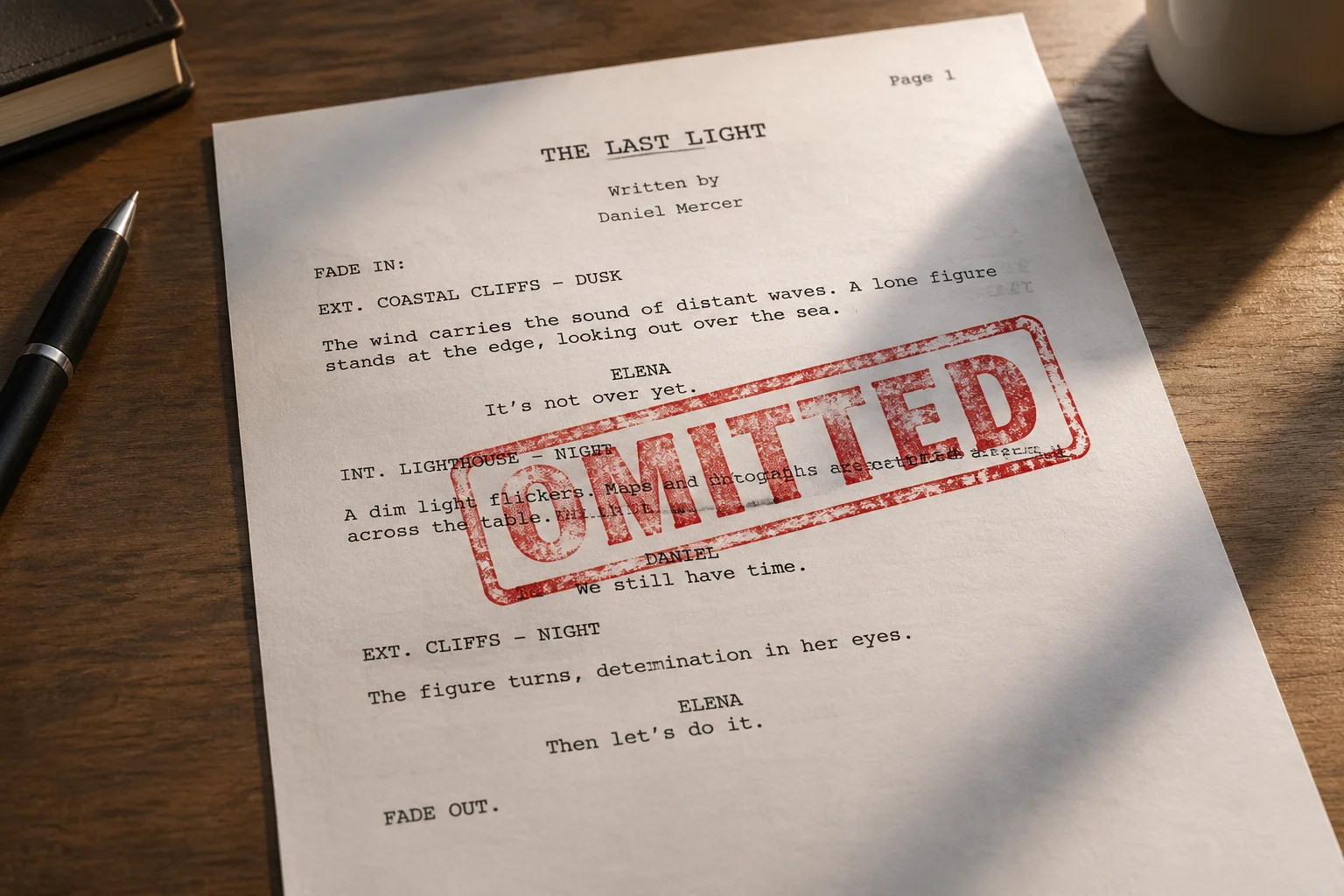
The Mechanics of Omission: Why Deleted Numbers Never Disappear
When a locked production draft loses a scene during script revisions, simply deleting the heading and letting the software renumber following sequences creates immediate operational failure on set. Production breakdown sheets, shooting schedules, digital stripboards, and department equipment orders are anchored to locked scene numerals. The industry standard protocol mandates that removed material must remain formally listed as OMITTED in the script draft.
In practice, omitting a scene replaces the scene heading and its descriptive action blocks with a concise single-line slug: the scene number followed by the centered or capitalized notation "OMITTED". By locking this placeholder, downstream departments immediately understand that the scene was deliberately removed rather than misplaced during paper collation or digital distribution. The numbering progression stays intact, preventing assistant directors and script supervisors from confusing old versions with new packets.
Once production numbers are locked, a sequence cannot be renumbered. If Scene 42 is cut, Scene 43 must remain Scene 43 forever. Reusing or shifting numbers corrupts call sheets, wardrobe continuity cards, visual effects tracking plates, and sound department log books.
The same rigorous preservation applies to entire physical or digital pages. When structural trimming removes enough dialogue or action to eliminate a full page, software that enforces locked pagination produces an omitted page marker. The page heading designates the page number alongside the date and color of the revision set, displaying a centered note confirming that the page content has been omitted. This eliminates confusion among crew members checking binder integrity.